
What This Article Covers:
This article explores how leaders and regional managers can navigate workplace pressure and turn destructive friction into productive outcomes using Everything DiSC strategies. You’ll learn how leveraging the power of time (through deliberate pauses, draft-saving techniques, and intentional silence) prevents knee-jerk reactions during tense interactions. The post also highlights how Everything DiSC conflict assessments provide teams with a shared language to build self-awareness, improve cross-functional communication, and handle everyday workplace tension with confidence.

In a recent DiSC training with regional service managers at Centimark, we heard from leaders who balance operations, tight timelines, intense sales targets, and heavy customer expectations every single day. They have a massive amount of heart, but they also live under a pressure cooker of competing priorities where practical conflict resolution is needed daily and often even digitally through our email and text communication.
In Everything DiSC teambuilding workshops we talk about communication, self-awareness, and one of the most real workplace dynamics every leader eventually has to face: conflict.
Conflict, as we know, is 100% inevitable, and we can’t avoid it. It’s the kind that shows up when customers are frustrated, timelines are tight, operations and sales are balancing different priorities, expectations keep shifting, and everyone is trying to do their best under intense pressure. Like any team, conflict can get tense.
But conflict can also be productive when it helps teams solve problems, hold each other accountable, and get to better outcomes.
One universal theme kept bubbling up in our discussion at the offsite:
The way we choose to respond in a heated moment can either create immediate calm or completely escalate workplace tension.
It sounds simple, but when you are in the middle of a heated conversation, a tense email, a frustrated customer interaction, or a cross-functional disagreement, it is not always easy. Our first instinct is often to react quickly. Instinctively, we push back to defend our stance and focus entirely on proving our point, desperate to make sure the other person understands exactly why we are right. And sometimes, underneath all of that, the ego just wants to win.
But one of the strongest assets we have in conflict is something many people underestimate: Time.
You have probably heard the expression:
Time is on your side.
When it comes to conflict, it really is. Time gives your nervous system a chance to settle. Time helps you decide whether your response is going to solve the problem or simply release the emotion. And in leadership, that distinction matters.

3 Workplace Conflict Resolution Strategies That Leverage the Gift of TIME
In all of our leadership workshops across New York City, New Jersey, Pennsylvania, and the Washington DC metro area, we map out three core strategies that change the dynamic of workplace friction. Whether you are leading a team of early leaders or training seasoned industry vets, these principles keep conversations healthy.
1. Give Yourself Time to Respond Instead of React
In conflict, speed is not always your best strength. Sometimes the most powerful thing you can do is not answer immediately. That may mean taking a breath before speaking. It may mean asking for a few minutes to think.
It may mean saying: “Let me take a look at this and come back to you.”
Then actually walk away. Not to avoid the conversation. Not to dismiss the other person. But to give yourself space to respond from a steadier place. When a manager pauses before responding, they are not being weak. They are creating enough space to choose the right response.
2. Write an E-mail or Text Response, Then Save It as a Draft
When emotions are high, we want to write the response. Get it out. Let the frustration, disappointment, confusion, or defensiveness land somewhere. The energy has to go somewhere. Just don’t hit send right away.
Save it as a draft. Come back to it later and ask yourself:
- “Is this clear, or is it defensive?”
- “Is this really what I am trying to convey?”
- “What outcome am I trying to create?”
That last question is the most important. Because most workplace conflicts do not worsen because of the original issue. They worsen because of how people respond to the issue. A sharp email. A rushed text. A tone that lands harder than intended. A message that reads like blame instead of clarity.
Sometimes the best thing you can do is write the first draft for yourself and the second final version for the relationship itself. Even better, ask someone in the office whom you trust to read it before you send it. Not some “yes-person” who will simply agree with you, but a trusted peer who will help you look at it objectively.
3. Allow Straight-Up Silence (Go Radio Silent)
This is a personal favorite strategy that I love to share during keynotes. I even put it in my TED talk (Speaking without Apology): radio silence. Silence feels uncomfortable, especially in conflict. Most of us want to fill the gap. We want to explain more. Smooth it over. Reduce the awkwardness.
But silence is not always a problem. Sometimes silence is the space where the other person is able to process. Sometimes silence is where the room takes a breath and it gives the conversation a chance to reset. And sometimes, silence gives the other person the same gift you are giving yourself: a moment to respond instead of react.
I won’t lie. Silence can feel awkward, but it also conveys confidence and showsyou are not afraid of the discomfort that comes with honest conversation. For those in sales, radio silence may sound very familiar: you ask the question, then you stop talking. You allow the other person to answer. The same principle applies in conflict. Say what needs to be said clearly, then let the silence do its work.

Implementing Everything DiSC Productive Workplace Conflict Resolution Training
Conflict is not the issue. Lack of self-awareness is. When people move through conflict without awareness of their automatic thought triggers and what causes their destructive thoughts, that’s when we feel a loss of control.
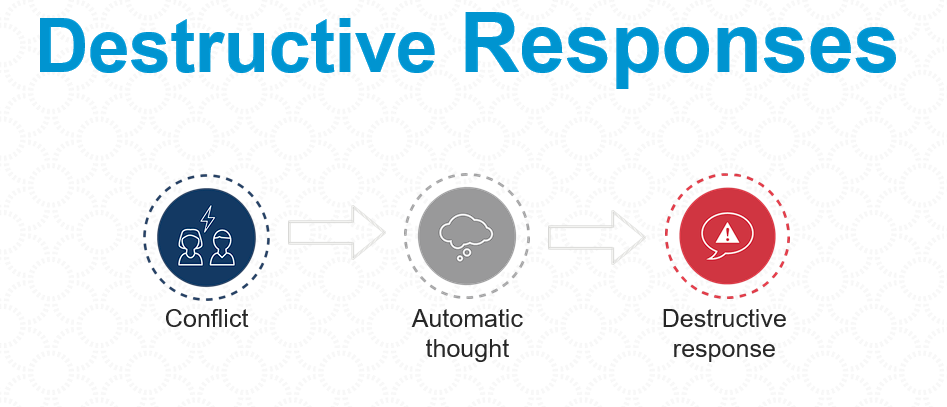
In our training, we leverage the personalized Everything DiSC conflict assessment to give teams a shared language for understanding why people communicate differently under pressure.
Some people become more direct. Others withdraw. And sometimes people just need reassurance before they can move forward. Choosing a deliberate approach to workplace conflict resolution ensures that misunderstandings don’t turn into long-term team fractures.
That is where conflict starts becoming productive. Not every conflict will be easy, and not every person will respond the way you hope or resolve the situation quickly. But when leaders model the ability to pause, regulate, listen, and respond with intention, they give their teams permission to do the same.
If your managers or teams are navigating conflict, communication breakdowns, customer pressure, or cross-functional tension, this may be a good time to bring those conversations into a facilitated workshop. They need a safe place to talk about the real tensions that show up at work with their peers. This hands-on method ensures sustainable workplace conflict resolution across all operational divisions.
To see how we take these behavioral insights even further by using hands-on situational practice, check out our recent guide on Manager-Employee Role-Playing with Everything DiSC Training.


Frequently Asked Questions (FAQ)
What is Everything DiSC Productive Conflict training?
Everything DiSC Productive Conflict training is a behavioral framework designed to help individuals increase self-awareness around their automatic responses to conflict. Rather than focusing on changing the conflict itself, it teaches participants how to curb destructive behaviors and consciously choose productive, healthy communication responses under pressure.
How do Everything DiSC workshops improve regional team communication?
Everything DiSC workshops provide a deep behavioral framework that helps individuals understand their unique communication styles and priorities. For regional managers facing intense operational pressure, DiSC training builds immediate empathy, teaches actionable ways to read behavioral cues, and provides concrete strategies to de-escalate tension during cross-functional conflicts.
About Us
In Our Shoes® partners with organizations to design and deliver leadership development, manager coaching, and AI workforce transformation programs. Our team has delivered training across industries for executives, directors, managers, and high-potential talent, and is certified in Everything DiSC® facilitation, change management, and AI-enabled learning design.
